What to Verify Before Signing With a Fragrance Manufacturer
Due diligence on a fragrance manufacturer is not a certificate folder and a factory walk-through. It is a short list of things that must be true and written down: who holds the compliance documentation, who owns the formula, which steps leave the site, and what happens when a material is reclassified. Everything on that list can be verified in weeks, and each item that is skipped becomes leverage later.
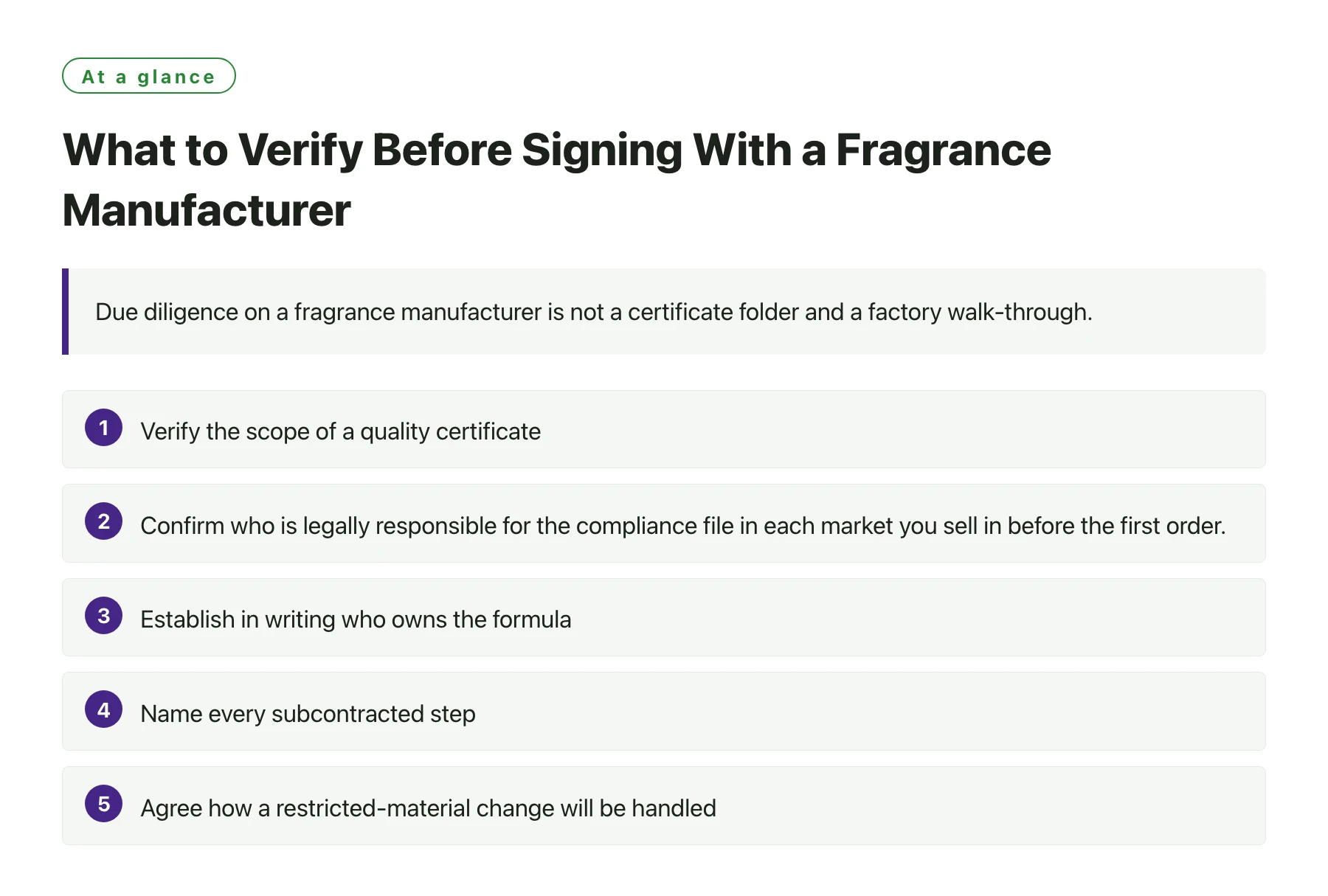
Key takeaways
- Verify the scope of a quality certificate, not just its existence, because scope is what applies to your product.
- Confirm who is legally responsible for the compliance file in each market you sell in before the first order.
- Establish in writing who owns the formula, the moulds and the artwork, and what is returned if the relationship ends.
- Name every subcontracted step, because unknown subcontracting moves quality control to a site you never assessed.
- Agree how a restricted-material change will be handled, since reformulation risk is a contract question as much as a technical one.
Most brands do the same checks in the same order: request certificates, ask for a quotation, request samples, then negotiate. That sequence verifies that a company exists and can make something that smells acceptable. It does not verify the things that cause disputes.
The disputes that actually happen are predictable. A restricted material is reclassified and the formula has to change. A certificate does not cover the category being produced. The brand wants to move production and discovers the formula cannot travel. A decorated component is bought from a third party nobody assessed.
Each of those is preventable with written answers obtained before signature. This article lists what to verify and in what order, so the checks finish before the commitment rather than during it.
The verification sequence
- Check the certificate scope, not the certificateAsk which product categories and which production lines the quality certificate covers, and when the last audit took place.
- Identify the responsible entity for each marketEstablish which legal entity holds the product information file and answers to regulators in every country you plan to sell in.
- Map the supply chain step by stepList compounding, filling, decoration, cartoning and labelling, and record for each whether it is done on site or bought in.
- Confirm the regulatory position of the formulaAsk which materials carry usage limits, how much headroom is left, and how the manufacturer monitors changes to those limits.
- Settle ownership and exit termsWrite down who owns the formula, the moulds and the artwork, where they are held, and what the brand may take if it leaves.
- Define what happens on a forced reformulationAgree who bears the cost and the timeline if a material restriction or a labelling change requires a revision.
- Verify the commercial terms against the samplesConfirm that the quoted price corresponds to the approved sample, including the packaging components, before signing.
Certificate scope and the compliance file
Certification for cosmetic manufacturing is normally built on a documented quality management framework, and independent testing and inspection organisations audit sites against it and publish what the standard does and does not cover [1]. The certificate is a statement about a system. Your product is a specific case inside or outside that system.
So the first question is scoping: which categories were audited, which lines, and which site. The second is documentation. In the European Union, for example, a responsible person has to hold a product information file for each cosmetic product placed on the market, and that obligation attaches to an entity rather than to a factory [2].
Ask who signs the compliance documents
For every market you sell in, there should be a named entity that holds the file, responds to a regulator and maintains the safety assessment. If the manufacturer is not that entity, find out who is and confirm the arrangement in the agreement.
This is a quick question with a long consequence. Brands that skip it discover the gap when a customs authority or a market surveillance body asks for documentation nobody has.
Check how material restrictions are tracked
Fragrance materials are subject to usage limits that depend on the product type and how it is applied, and the standards that set those limits are reviewed and updated [3]. A manufacturer that monitors them has a process; one that does not will hear about a change from a customer.
Ask how you would be notified if a material in your approved formula were affected. The answer tells you whether reformulation risk is managed or merely survived.
Confirm the label obligations follow the formula
Allergen declaration and ingredient listing obligations attach to what is in the finished product and in which market it is sold. They are not determined by the name of the fragrance tier or by the size of the bottle.
Because those obligations can change with a formula revision, the agreement should say who updates the artwork and who pays for it when a change is forced.
The verification list, and what a weak answer looks like
| Item to verify | The proof that settles it | Warning sign | Consequence if skipped |
|---|---|---|---|
| Certificate scope | Audited categories, lines and date of the last audit | A scanned certificate with no scope discussion | A quality system that does not actually cover your product type |
| Compliance responsibility | Named entity holding the product information file per market | The manufacturer says it handles everything | Documentation gaps at the border or during market surveillance |
| Subcontracted steps | A step-by-step list naming who performs each operation | A general statement about partner factories | Quality control sitting at a site nobody assessed |
| Formula and mould ownership | A written clause naming what the brand may take and hold | A verbal assurance that everything is yours | Loss of the product's core asset when the relationship ends |
| Restricted-material changes | A notification process and a cost-sharing position | No process, or a promise to inform you informally | An unplanned reformulation and re-labelling at your cost |
| Design rights on the pack | Confirmation of who registered what, and where | Shared or unclear authorship of the design | A design dispute in the market where you sell most |
Six rows, six written answers. If a supplier cannot produce an answer for a row, that is information in itself, and it is information you want before signature rather than after.
The two items brands most often leave vague
Ownership and design rights are the two areas where verbal comfort is common and written clarity is rare. Both are cheap to fix while the relationship is good and expensive to fix afterwards.
Design rights deserve particular attention because packaging is where a brand's visual identity lives. Bottle shapes, closures and decorative elements can attract registered design protection in multiple jurisdictions, and the registration position determines what may be copied, adapted or sold in each market [4].
Formula ownership in plain language
Ask three questions: is the formula developed exclusively for us, may we take it to another manufacturer, and what physical or documentary form does it take if we do. If the answer to the first is no, the formula is a licence rather than an asset, and it should be priced accordingly.
Also clarify what happens to stability data, test records and the specification sheet. A formula without its documentation is harder to transfer than the clause suggests.
Design rights on the pack
Ask who commissioned the design, who is named as the applicant on any registration, and whether the shape can be used in markets where a third party holds prior rights. Those questions are ordinary in packaging projects and should not be treated as an accusation.
Record the answers alongside the submission files so the position is documented if the relationship changes. A walkthrough of what to verify before signing with a fragrance manufacturer is a reasonable starting point for building your own version of this list.
The most common mistake is treating all of this as paperwork that can be completed after launch, when a supplier is motivated to be accommodating. Verification is cheapest while nothing is at stake. Once the artwork is printed, the launch date is set and the first purchase order is placed, every gap in the agreement becomes a negotiation you are likely to lose, because the cost of stopping is higher for you than for the supplier. Finish the list before signature, and keep a copy of every answer.
Sources
- SGS: Cosmetics, Personal Care & Household Testing —— Testing, inspection and certification services for cosmetics and personal care, including microbiological, stability and safety testing aligned with cosmetics GMP.
- European Commission: Cosmetics in the EU —— The European Commission's overview of EU cosmetics rules, including the responsible person, product information file and safety report requirements.
- IFRA Standards Library (International Fragrance Association) —— The IFRA Standards Library lists the restrictions the fragrance industry applies to individual fragrance ingredients, based on safety assessments; it is the reference point for compliant fragrance formulation.
- WIPO — World Intellectual Property Organization —— The UN agency for intellectual property; resources on industrial design and patent protection relevant to product and packaging design.
Frequently asked questions
Do I need a lawyer to review a fragrance manufacturing agreement?
For a first agreement or a large commitment, review by someone familiar with supply contracts is worth the cost, particularly for ownership, exclusivity and liability clauses. For smaller orders, at minimum obtain written answers to the verification list and keep them with the agreement.
What is a product information file and who should hold it?
It is the compliance dossier required for a cosmetic product placed on the European market, containing the safety assessment and supporting data. It must be held by a responsible entity in the market. Confirm which company holds it for your product and that the arrangement is documented.
How do I verify a certificate is genuine?
Check the certificate number and issuing organisation directly with the certifier rather than only accepting a scan, and ask which sites, lines and categories are covered by the certification. Scope and validity dates are the parts that matter most.
Should the agreement cover reformulation costs?
Yes. Material restrictions can change, and when they do, someone has to revise the formula, retest it and update the artwork. Agree in advance who pays for each of those steps and how quickly the notification will be given.
What happens to my moulds if I change manufacturer?
That depends entirely on what the contract says and who paid for the tooling. A mould paid for by the brand is usually the brand's property, but arrangements differ on where it is stored and whether it can be released to a third party. Settle this before tooling is ordered.